
In this extra episode, Beatriz Acevedo explores the multimodal work of Cecilia Vicuña in her major retrospective at the Whitechapel Gallery in London (running until 14 February 2027). She talks about unravelling creativity, poetry, identity, and the power of making art with whatever is at hand. Beatriz reflects on the artist’s question, ‘What Does Poetry Mean for You?’ which Vicuña explored through a series of videos around the city of Bogota in 1979.
Beatriz wonders, “What creativity means for us?” and how we can be inspired by Vicuña and should not be limited by ideas of expertise, media or modalities, but simply follow ‘the thread’…
Exhibition website: https://www.whitechapelgallery.org/exhibitions/cecilia-vicuna/
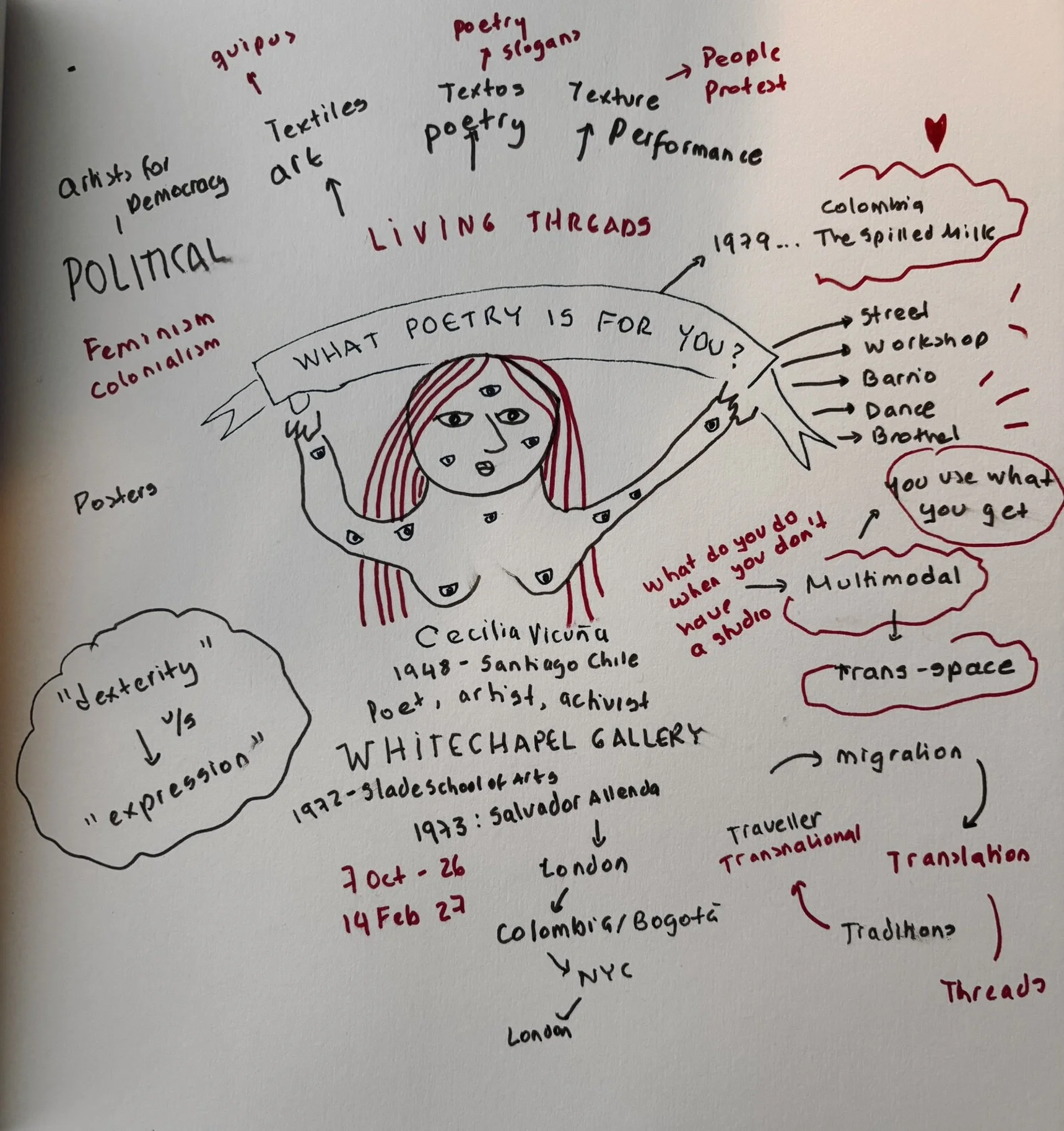
Beatriz’s notes from the exhibition
Transcript (automated)
Hello, I would like to talk today about an exhibition that is in London about the great artist Cecilia Vicuna. She was born in 1948 in Santiago de Chile, South America, and there is a big retrospective of her work in Whitechapel Gallery in London.
It started on the 7th of October and it goes until the 14th of February, 2027.
This is a new exhibition for this wonderful artist who works in the interrelationship of textiles, textuality, and texture. She works in art, in poetry, and performance. She's one of the most prolific and political artists of our time.
And indeed, she also is one of those artists that is difficult to pinpoint, to say, no, this artist does only this. And I think that is very relevant for us in the creativity conversations, because it is telling us
What is creativity? We were talking recently about the itch, the urge of saying something. And Cecilia Vicuna is one of those artists that tell us that when it is ageing, go on scratching, even if you don't have any paper or a studio or even a place to
call home. Her art is a travelling art. She trained in Santiago de Chile, and then she got a scholarship to come to the Slade School of Art in 1972. In 1973 was the
coup against the Salvador Allende, the military coup, and she decided to stay in the United Kingdom, and she began to be more committed to political issues. And she founded a group, Artists for Democracy, and she worked in every...
medium that she found around. So the exhibition brings together different aspects of her work. And it's interesting because Whitechapel is in a way, have different floors and different rooms, different galleries. And then every time that you go to one of these different rooms, you see something
new, something different, something that you need to connect it. You need to connect the dots amongst those many threads that she is weaving for us.
So in the first gallery, there is this Living Threads, which is a big installation of a red textile that is hanging from the floor. And it is related with the Andean and Inca system of mathematics that is called the Kipuz,
which are some form of nothing. So this is a big installation. It's very moving, like interacting with it. But it's also telling us what is texture, what is textile, how will we communicate with each other? And it is.
really nice. And also then you move around and then you see her poetry. She won a contest when she was 18 years old. She has been working very much about words, words and activism, words and politics, words that people say,
poetry, et cetera. So really interesting. So the first question that came to me in this exhibition is, what do you do creatively when you don't have a studio? And we talk a lot about the studio, going to the sketchbook, et cetera. These are places and spaces for creativity.
But what about if you're travelling? What about if you don't have a studio? And I think that what is so interesting from Cecilia Bicuna is that use of everything you have at hand. Yeah, so she was in this trans space, in this multimodality.
She is a migrant, but she's also an English speaker, very fluent. So she was in these transitions at these liminal spaces between English speaking, Spanish speaking, so this translation that you are doing all the time, and this idea of the thread, what is the thread that connects all those things?
She's A traveller, she's transnational. Her work has been exhibited in London. Then she went to Colombia around 1979, around that time. And that was the part that I found more moving because
I knew about Cecilia Vicuna in Colombia, but seeing the connexion with London, with New York, with Miami, with, I'm back to Bogota and London, that is very exciting for me because that is telling me about how creativity travels and how creativity travels.
unravels and it's a beautiful theme for us. There's another interesting thing about her work that we talk a lot in creativity is creativity about dexterity, like to master a technique to be the best portrait or to use the best
watercolour techniques, or it is a matter of expression. And I felt that what she does is to use everything that is at hand. If she has in front of her just a piece of paper to make a poster, she does it. If she uses also textile art and also following very much the art of the arpilleras, the Chile, which is a textile art that is
using domestic spaces, but it was used as a way of communicating about the abuses of the dictatorship. Then she uses that, but she uses also magazines, and she uses collage, and she uses video, and she uses everything that she has at hand. So it's very interesting to see that.
The medium should not be a limitation for creativity. Yes, it's true that we want to make the best of what we want to say using mediums that can be writing, that can be painting, that can be printmaking. But the interesting thing here is how you use
Them.
not that they use you, you know, so how you are in control as a creative, you can gain dexterity, but the message, that age, that urge that we were talking last time, how that is expressed. She's also very famous or very one of the
artists that work a lot about political issues, feminism, colonialism. She come from the south of Chile that historically has been a place that have been in the periphery of the white people in the centre, no, or in the north.
And historically also, the people from the south, the Mapuches, were resistant to any sort of colonisation or invasion, etc. They were never defeated by the Spanish. They were impoverished and cornered, but never defeated. So that's so interesting too, you know. So how she was in all this identity.
that we have as Latin Americans. As Latin Americans, we have the Spanish heritage, yeah, people who came in the 15th and 16th century. Chile in particular also has a huge...
input from migration because Chile and Argentina invited people to from different countries in Europe to come and populate the country and ask politics, you know, politics from a state. But we also have a very strong root in the indigenous
communities in the Andes, especially, and all over South America. But also we have the legacy of slavery and Afro people. So we are complicated people, but I think that what she does is to manage to negotiate those different identities
through her art. You know, the consideration of the kippus is very beautiful. And also her consideration of what is poetry and her use of the body also talks about her heritage. But also she's able to establish a dialogue with different cultures, with different traditions,
So she moves, and I love that idea of travelling and flowing, if you want, and moving between different cultures. She's London, she's in New York, she's in Bogota, and she is herself. And she's a wonderful woman, really interesting art.
So the one that I wanted to talk about, which was truly beautiful, was a series of videos that she was doing at the end of the 70s and the 80s. So think that this is not digital videos, it's a lot of them, they are analogue, basically. She's going around with a frame, with a camera, and she with a microphone asking people.
And she, when she lived in Bogota, she lived in Bogota because at the time, Colombia, in the 19th, Colombia has never had a dictatorship, per se. Well, we have a couple of years of general coup, but it was really very short-lived.
compared to the rest of South America, Latin America, where there were a lot of coups and military dictatorships as part of the Cold War, also, Colombia kept
kept, we kept our democracy with problems, yes, with the abuses, yes, with the, yeah, with all the problems and the poverty, et cetera, but we managed to keep democracy and some sort of freedom. So she went to Bogota to live in those times.
of the end of the 70s, beginning of the 1980s. And she goes around asking people, what poetry mean for you? What does poetry mean for you? And it's beautiful because she take to the street, she take to the workshop, you know, the working
people. She talks to people in the neighbourhood, in the barrio, especially a barrio that was created after the displacement of thousands of people from the countryside to the city, and it became a very sort of politically active neighbourhood called Policarpa. She also goes to the club, to the clubs, and there was one
It's called the, what's the name of the club? The club is called Gose Pagano. And it's actually a melting pot of influences, especially they were very adamant into bringing salsa, which is a music from the
from Cuba, but also that established amongst Afro-Colombian people in Cali and the West Pacific.
So very interesting to go to that club, which actually I used to go, which made me feel a bit old. The club closed around 1995, I think that that was the last time that I went there. And so it made me laugh to see the melting pot of that club and people, there were a lot of Afro-Colombian people. And the answers of
people about what poetry means for you. And that was beautiful, you know, everybody.
has an idea of what poetry is for them. She interviewed also children, people in the street. But she didn't go to the so-called established poets of the world, was she? No, she went to the street to ask what poetry means for you. And everybody have an answer.
Some people say that poetry was about beauty. Many talk about poetry es algo bonito, which is something beautiful, something cute, something pretty, something that is important for life, which made me think a lot also about my own project on beauty. So that was
Quite interesting. So that idea of working with people, which also reminds me a bit of the art of Julio Le Park, the Argentinian artist that is also exhibiting at Tate Moderna, who passed away this year, being 97 years old, something like that, really.
That idea of working with the people, that how in Latin America these popular artists art with people is so powerful, perhaps because the political situation is so intense. But I think that there is something about embracing
art and creativity as a human expression. And what I was very moved to see was how everybody, the person in the street, the worker who is, you know, hammering something in the car body shop.
they have something to say about poetry, but also the dancer and the worker and the, you know, even the streetwalkers have to say something about poetry. And that made me think about this idea of creativity for all and beauty for all.
And how we need to bring beauty and poetry and...
creativity back to what it is to being human. And that was so interesting for me from this exhibition. So definitely a must for your agendas is ending on the 7th, the 14th of February, 27, and really hope
that you get to experience and also that you wonder not only what poetry is for you, but what creativity is for you. How do you live the creativity? How do you live creatively? No matter the medium, no matter your dexterity, no matter how expert you are,
in a field or how good you know the tools. Go out with what you have and scratch that itch. So thank you very much. Hope you enjoyed.
